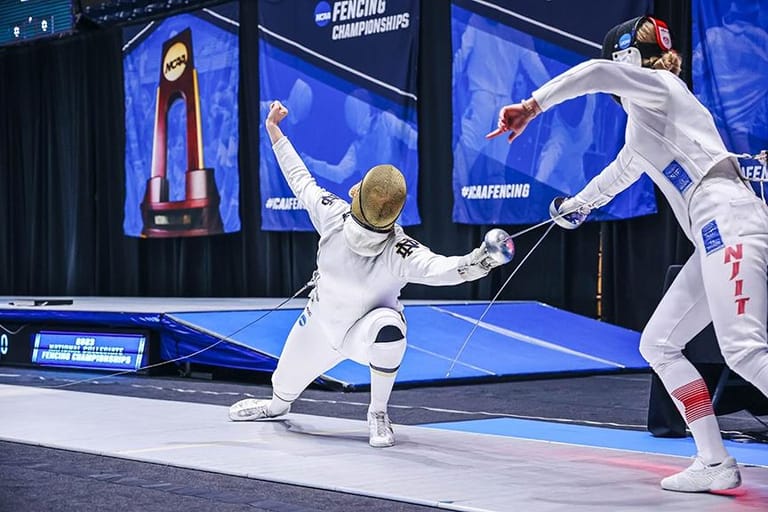
30% of Fencers Compete in College. 7% of Soccer Players Do.
Strategic families do the math. Boulder's premier épée academy has built college athletes for over 45 years, and we've mapped every step of the pathway.
All equipment provided. No experience necessary.
30-38%
HS fencers compete in college
64%
College recruitment in épée
29
Division I programs
$200K+
Average scholarship value
The Numbers Behind the Pathway
Fencing is one of the most favorable sports in college athletics for recruited athletes. 35% of female high school fencers continue to compete at the college level, compared to just 8% for the average high school athlete. For males, the rate is approximately 28%.
Recruited fencers at Ivy League schools enjoy admission rates of 70-90% versus the general applicant rate of 3-5%. The total four-year value of admission to an elite institution ($320,000-$380,000 in tuition alone) makes fencing one of the highest-ROI youth sports investments.
How College Fencing Recruiting Actually Works
College fencing recruiting operates on a different timeline than most sports. Coaches identify prospects early, and athletes who understand the timeline have a significant advantage.
Sophomore Year: Get Visible
- Compete in at least one USFA regional tournament
- Begin building a competitive record with national points
- Create a basic athletic profile (ranking, coach reference, academics)
- Research programs matching your athletic and academic profile
Junior Year: Make Contact
- Reach out to college coaches directly (NCAA rules permit this)
- Send recruiting videos: épée technique, footwork, tournament footage
- Attend college fencing camps for in-person evaluation
- Request unofficial visits to top-choice programs
Senior Year: Commit
- Official visits and scholarship discussions
- NCAA timeline for early decision and regular admission
- Final competitive season results matter. Maintain your ranking
Why Your Child's Weapon Choice Matters
Not all fencing weapons are equal in the eyes of college recruiters. Épée accounts for 64% of all college fencing recruitment, making it the highest-demand weapon by a significant margin. At NCF Boulder, we specialize in épée. Every element of our curriculum is designed around the weapon that gets athletes recruited.
Where Fencers Go to College
Division I Programs (29 schools)
Division II
1 school
Wayne State UniversityDivision III Programs (15 schools)
College Pathway Support, Built In
NCF Boulder doesn't just train athletes. We provide the infrastructure competitive families need to navigate college recruitment.
Quarterly College Prep Seminars
Recruiting timeline workshops for Advanced athletes and families. What coaches look for, how to make contact, how to read a scholarship offer.
Fencing Resume Development
Competition record, rankings, academic profile, coach statement. Formatted for NCAA recruiting standards.
Recruiting Timeline Guidance
From first tournament entry to signing day, we help families understand where their athlete stands and what comes next.
Coach Introduction Facilitation
Where appropriate, we facilitate warm introductions between NCF Boulder Advanced athletes and college coaches we have relationships with.
NCF Boulder's Track Record
NCF head coach Gary Copeland has produced 64 Junior and Cadet World Championship and Pan American team selections, the level of competitive results that drive college recruitment.
Our alumni include Jasmine McGlade, who was the #1 ranked US women's epee fencer (Junior/Cadet), a two-time Junior World Team member, and a Harvard fencer who earned NCAA team champion and individual All-American honors. She returned from a 10-year retirement in 2024 and immediately won the 2025 Vet-40 national title, qualifying for the World Team.
In 2025, current NCF youth fencer Maddie Burks won a Pan American silver medal in Youth Women's Epee, the kind of international result that puts a fencer on every college coach's radar.
Verified NCF Boulder Alumni University Placements
Fencing vs. Other Sports: College Conversion
| Sport | HS to College Rate | Elite School Concentration |
|---|---|---|
| Fencing | ~30-35% | 7 Ivies, Stanford, Duke, MIT, Notre Dame |
| Rowing | ~20% | High (Ivies, Stanford) |
| Soccer | ~7% | Broad distribution |
| Basketball | ~3.5% | Broad distribution |
| Climbing | 0% | No NCAA programs |
Frequently Asked Questions
When should my child start fencing if the goal is college recruiting?
Earlier is better, but "early" is relative to the pathway, not just age. A child who starts at 12 with consistent, high-quality coaching can reach a recruitable level by junior or senior year. A child who starts at 8 has more runway. What matters is stage progression: reaching Advanced level, accumulating national points, and engaging the recruiting process proactively.
What about scholarships? Is there real money available?
Yes. Division I programs offer athletic scholarships that can be substantial. The average total value for a recruited D1 fencer across four years exceeds $200,000. Ivy League programs don't offer athletic scholarships, but recruited athletes receive significant preference in admissions, which has its own financial value when considering $360,000+ in tuition.
Does my child need to be nationally ranked to get recruited?
Not necessarily. While top D1 programs pursue nationally-ranked athletes, many strong D3 and mid-major D1 programs recruit athletes with solid regional records and good academic profiles. The key is identifying programs that match your athlete's competitive level, something we help Advanced athletes navigate.
Why is 64% of college recruitment concentrated in épée?
Épée is the only weapon with no right-of-way rule and a whole-body target. This makes it the most accessible weapon to develop and the most natural for college-level competition. Because most new fencers default to foil, épée rosters are harder to fill, and coaches recruit for it actively. NCF Boulder specializes in épée.
Is there an Ivy League connection to fencing?
Yes. 7 of 8 Ivy League schools have active NCAA fencing programs. Fencing athletes frequently gain admission to highly selective schools. The academic profile of the typical competitive fencer (disciplined, strategic, intellectually engaged) correlates with selective admissions criteria.
Start Your Pathway Today
Your child doesn't need to be a recruit today. They need a first class, a qualified coach, and a progression system built to get them there.